Loose asphalt millings take up more space than the same material after suitable compaction. The material delivered by truck and the finished rolled driveway are measured in different states. To order the right quantity, make sure your volume and bulk density describe the same state—or use a documented conversion for the exact material.
For a finished driveway, the most direct tonnage calculation is finished compacted volume × a compatible compacted bulk density. If you already use that method, do not add a second generic compaction percentage. If the supplier quotes loose cubic yards, you need the corresponding loose bulk density or a documented conversion factor for that specific material. Compaction does not make dry stone or asphalt binder disappear.
What Are Asphalt Millings?
Asphalt millings are particles of existing pavement recovered for reuse. Their technical name is reclaimed asphalt pavement (RAP). They contain mineral aggregate coated with residual asphalt binder. Milling machines cut material from an existing paved surface; removed pavement can also be broken up, crushed, screened, and processed into RAP. “Millings” is the material, while “milling” also describes the pavement-removal operation.
The Federal Highway Administration’s RAP material description distinguishes milled from crushed RAP, notes changes in particle size during processing, and explains that stockpiles can vary by original pavement source, gradation, binder, moisture, and incidental material mixed in during removal. RAP is reused in asphalt mixes, granular bases, stabilized material and some fill applications. Those uses have different specifications: recycled asphalt used as an unbound driveway surfacing material is not automatically equivalent to a new engineered hot-mix asphalt pavement.
If you are requesting a quote, specify whether you want directly milled RAP, screened or crushed RAP, or a graded blended product. Those names do not guarantee matching bulk densities.
Loose vs Compacted Asphalt Millings at a Glance
| Question | Loose RAP | Compacted RAP |
|---|---|---|
| Physical condition | Stockpiled, truck-loaded or freshly spread; those loose conditions can still differ. | Rolled or otherwise densified in a finished layer, or a laboratory specimen compacted using a named procedure. |
| Volume | Space occupied by the material as piled, delivered or measured loose. | In-place finished geometric volume, or a specified compacted specimen volume. |
| Bulk density | Mass divided by the *loose* total volume, including voids between particles. | Mass divided by the *compacted* total volume, including remaining voids. |
| Moisture | Wet truck weight can include stockpile water. | May be measured as field wet density or laboratory maximum *dry* density; not interchangeable. |
| Ask the supplier | Loose pounds per cubic yard, moisture basis, weight ticket and measuring method. | Tested in-place or laboratory dry density, method, compaction specification and relevance to this product. |
| Typical estimating error | Multiplying a finished layer's cubic feet by a loose truck density. | Multiplying loose truck volume by a compacted specimen density. |
A stockpile scooped into a truck may settle differently from material newly spread on the ground. “Loose” alone is not a sufficiently precise test method. Likewise, a laboratory’s maximum dry unit weight is not automatically the density achieved on a homeowner’s driveway.
Why Asphalt Millings Change Volume During Compaction
Loose particles contain spaces between them. Rolling and vibration can rearrange the particles, bring smaller pieces into gaps, and reduce some of those spaces. For the same dry material mass, reducing total bulk volume increases dry bulk density. That explains why a finished layer may occupy less volume than the quantity measured in loose condition.
The amount of change depends on the RAP source, particle-size distribution, residual binder, starting condition, available fines, material temperature, moisture, layer thickness, roller or plate compactor, compaction effort, base support and how the result is measured. Large lumps, a wet pile, and finely processed material should not be assumed to behave alike.
The FHWA’s embankment and fill guideline discusses RAP quality control and compaction inspection for its highway-fill context. It is not a homeowner-driveway recipe, and it does not establish a nationwide percentage of volume shrinkage for a delivered truckload.
Asphalt Millings Density Explained
Bulk density means the mass of a specified quantity of RAP divided by the overall volume that quantity occupies, including the voids between individual pieces. In US material estimates, it is often reported in pounds per cubic foot (lb/ft³) or converted to US short tons per cubic yard.
These measurements answer different questions:
- Loose bulk density: mass per unit loose stockpile, haul or placed volume. It needs a clearly stated loose measurement condition.
- Compacted bulk density: mass per unit volume in a specified compacted condition. A field measurement and a laboratory result can differ.
- Dry unit weight: mass of dry solids per total bulk volume. It excludes water mass but not the void volume.
- Wet or as-delivered bulk density: includes water in the measured mass. It may matter to a truck-scale invoice.
- Particle specific gravity: concerns the material particles relative to water, not the void-filled bulk pile. It is not a substitute for bulk density.
Ask whether the supplied density is for loose or compacted RAP, and whether the measurement is wet or dry. Those details determine which volume it can be used with.
To convert a compatible density to a cubic-yard weight, multiply by 27 ft³/yd³. To express that result in US short tons, divide pounds by 2,000 lb/short ton. A metric tonne is a different unit, so a quote labeled only “tons” needs clarification.
What Does FHWA Say About RAP Density?
The FHWA’s archived RAP material description, FHWA-RD-97-148, reports a historical 120–140 lb/ft³ unit-weight range for milled or processed RAP. It separately reports 100–125 lb/ft³ for maximum dry compacted unit weight in a mechanical-property context, citing different underlying investigations.
Do not pair 120 with 125, or 140 with 100, and call the result an actual compaction factor. Those are not documented before-and-after observations of the same sample, at matching moisture, packing and test conditions. A counterintuitive comparison—one reported “compacted” range being lower than a separately reported processed-material range—is precisely why context matters. The first discussion notes stockpile moisture and source aggregate; the second concerns maximum dry density and mechanical behavior. Published labels alone do not make the two datasets compatible.
FHWA also reports that stored RAP can absorb water; its historical source describes measured stockpile moisture levels, not a guaranteed moisture correction to use on every delivered truck. These are valuable research observations, not national ordering presets.
A later FHWA technical report, Alternative Backfills for Highway Applications (2024), reviews RAP among engineered alternative backfills, where gradation, design criteria, application and environmental considerations matter. It should not be read as a blanket approval of any driveway millings layer.
How Much Do Asphalt Millings Compact?
There is no reliable universal percentage such as “every load compacts 20%” or “always add 25%.” A legitimate project-specific percentage requires paired observations of the same RAP, measured with a consistent dry or wet mass basis and a clearly stated definition of the starting and final conditions.
The Wisconsin DOT’s December 2023 weight-volume study, WHRP G22-05, measured six samples of 1¼-inch RAP base among 29 aggregate products in Wisconsin roadway research. Its Table 4.11 reports 1.64–1.71 tons per cubic yard as studied conversion-factor values and 35–46% “compacted to loose” expansion factors for those RAP base samples. The report compares maximum dry and loose dry unit weights and defines the aggregate expansion using their density ratio (see Chapter 1, Eq. 5, and Chapter 4, §4.3, Table 4.11). The percentages are based on its defined compacted-to-loose volume denominator and test program.
Those reported figures are not a generic truck delivery factor or a compaction percentage for all driveway millings. The material gradation, test states, Wisconsin samples and measurement conventions must match before using such a factor. Don’t add the WisDOT percentage onto an unrelated bulk-density calculation.
Two different ways to express the same hypothetical volume change
Suppose the same material occupies 146.67 ft³ loose and 120 ft³ compacted:
- Extra loose volume relative to finished volume: (146.67 / 120 − 1) × 100 ≈ 22.2%.
- Reduction relative to starting loose volume: (1 − 120 / 146.67) × 100 ≈ 18.2%.
Both percentages describe the example, but their denominators differ. If someone says “20% compaction,” ask whether they mean extra loose volume relative to final volume or shrinkage relative to loose volume. They are not interchangeable.
Loose Volume vs Finished Compacted Volume
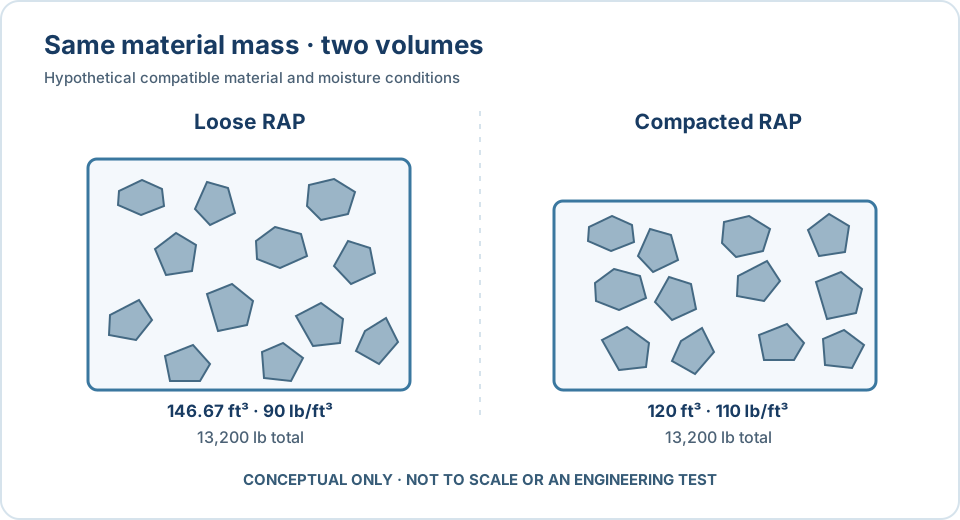
For matching material and a consistent mass and moisture basis, the mass remains the same:
Mass (lb) = loose volume (ft³) × compatible loose density (lb/ft³)
Mass (lb) = compacted volume (ft³) × compatible compacted density (lb/ft³)
Loose volume = finished compacted volume × (compacted density / loose density)
That last relationship uses two compatible densities for the same RAP. Don’t combine unrelated FHWA endpoints or a new-asphalt density with a loose RAP density. Changing water content between weighing and placement additionally requires a dry-mass or moisture correction.
How to Calculate Asphalt Millings Tons
Use the finished compacted layer when that is what you can measure reliably. For a rectangular area:
- Area (ft²) = length (ft) × width (ft).
- Finished volume (ft³) = area (ft²) × finished compacted depth (in) ÷ 12.
- Finished volume (yd³) = cubic feet ÷ 27.
- Mass (lb) = finished cubic feet × compatible compacted bulk density (lb/ft³).
- US short tons = pounds ÷ 2,000.
Worked driveway example: 40 × 12 feet, 3-inch finished layer
Assume a rectangular driveway 40 ft long and 12 ft wide, with a target 3 inches after compaction:
| Step | Arithmetic | Result |
|---|---|---|
| Area | 40 × 12 | 480 ft² |
| Finished volume | 480 × (3 ÷ 12) | 120 ft³ |
| Convert volume | 120 ÷ 27 | 4.44 yd³ compacted |
| Example compacted density | 110 lb/ft³, hypothetical | Not a universal RAP value |
| Required material mass | 120 × 110 | 13,200 lb |
| Convert to short tons | 13,200 ÷ 2,000 | 6.60 US short tons |
Important: The 110 lb/ft³ compacted density is a deliberately hypothetical calculation input. It is not a universal RAP density. Replace it with a relevant, material-specific density, and confirm whether a dry figure matches the purchasing mass basis. 6.60 tons already incorporates the effect of using finished compacted volume with compacted density. Adding an unrelated “25% compaction adjustment” would double-count an assumption.
The existing Asphalt Millings Calculator handles measured sections, compatible density inputs, supplier units and rounding. This guide explains the physics rather than replacing the calculator.
How to Estimate Loose Delivery Volume
Some suppliers sell by weight; others quote “a yard” of material. A loose cubic yard means volume in an identified loose state, not a cubic yard of finished rolled driveway.
For the same hypothetical example, suppose the same RAP at the same mass/moisture basis has a loose bulk density of 90 lb/ft³ and a compacted density of 110 lb/ft³:
- Mass: 13,200 lb, from the finished layer above.
- Loose volume: 13,200 ÷ 90 = 146.67 ft³.
- Loose cubic yards: 146.67 ÷ 27 = 5.43 yd³.
- Loose-to-compacted volume factor: 110 ÷ 90 ≈ 1.222.
- Extra loose volume versus finished volume: about 22.2%.
This is an illustration with a deliberately paired hypothetical density set, not a recommended compaction factor. If you lack a credible density pair or supplier-tested factor, do not claim you know the loose delivery cubic yards. Order by mass if a reliable compatible compacted density is available, or ask the supplier for tested material-specific values.
A nominal truck-bed capacity does not necessarily equal delivered RAP volume: payload weight, uneven pile geometry, moisture, legal limits and load practice all matter. Request the supplier’s actual weight ticket, permitted payload, load increments and measurement policy.
Asphalt Millings Weight per Cubic Yard
One cubic yard contains 27 cubic feet, so a cubic-yard weight depends directly on the state-specific bulk density:
lb per yd³ = density (lb/ft³) × 27
US short tons per yd³ = (density × 27) ÷ 2,000
The following is a hypothetical same-material comparison, not a product chart:
| Material state assumed | Density input | Weight of 1 yd³ in that state | US short tons/yd³ |
|---|---|---|---|
| Loose (illustrative) | 90 lb/ft³ | 2,430 lb | 1.215 |
| Compacted (illustrative) | 110 lb/ft³ | 2,970 lb | 1.485 |
A cubic yard of each state holds a different mass; a fixed mass occupies different yardages. A quote of “1.5 tons per yard” is incomplete without the specific RAP type, material condition and moisture/measurement basis.
How Much Area Does One Ton Cover?
Coverage is the reverse of tonnage. At an assumed 110 lb/ft³ compacted density, one US short ton of dry-basis-consistent material corresponds to:
- Finished volume: 2,000 ÷ 110 ≈ 18.18 ft³.
- Coverage at a finished 3-inch depth: 18.18 ÷ (3 ÷ 12) ≈ 72.73 ft².
That is the geometric coverage of the example before handling allowance. A thicker finished layer means less area per ton, and a higher applicable compacted density also reduces covered area per ton. It is not a general claim that a delivered ton of millings covers 72.73 square feet in every driveway.
Does Moisture Change Asphalt Millings Weight?
Yes. Water stored between RAP particles can add to the as-delivered scale weight. The archived FHWA material description expressly notes rain-related moisture uptake and variable stockpile conditions.
For the same dry material, wet mass = dry mass + water mass. If moisture is defined on a dry-mass basis, wet mass equals dry mass × (1 + moisture fraction). But do not use a moisture correction unless you know how the supplier’s moisture and density were measured. A laboratory maximum dry density and a wet invoice weight are not equivalent numbers.
Ask whether the quoted tons are as received, whether free water or stockpile moisture is included in weighing, and whether density values were measured wet or dry. Moisture varies; there is no sound nationwide adjustment percentage for every RAP load.
Asphalt Millings vs New Asphalt Density
Asphalt millings are reclaimed aggregate with residual binder. New hot-mix asphalt is a designed and placed asphalt mixture with different temperature, mixture and compaction controls. A new hot-mix density chart should not be used as the loose density of a stockpiled RAP product.
Even when both are called “compacted,” density comparisons require matching units, moisture basis, material specification and laboratory or field testing conditions. FHWA separates granular RAP use from RAP blended into new asphalt mixtures for exactly this type of application distinction.
How Much Asphalt Millings Should You Order?
Treat the material requirement and the purchase order as different steps:
- Measure the surface. Divide irregular areas into measured rectangles or use a surveyed area; record units.
- Confirm the required finished layer. Finished depth and structural adequacy depend on the actual base, local standards, expected traffic, drainage and installation design. This article does not prescribe a universal driveway depth.
- Calculate finished volume. Length × width × finished depth, with inches converted to feet.
- Confirm product and data. Find material-specific compacted density or a documented loose-volume calculation method with compatible measurements.
- Estimate mass. Use finished volume × compacted density, or loose volume × matching loose density. Never mix those states.
- Consider handling allowance separately. Add only a defensible amount for expected spillage, irregular edges or other measured handling loss—not a second compaction percentage.
- Check selling increments and minimums. Always round up to the supplier’s actual purchase increment.
- Confirm truck constraints. The quantity that fits in one load depends on payload limits and logistics, not solely bed volume.
- Write down the order. State the RAP product, estimated tons or loose yards, density basis, allowance, rounded quantity, rate, delivery and any additional charges.
Worked order and price example
Continue the hypothetical 6.60 US short tons estimate. Assume a 5% handling allowance, solely for illustration:
- Adjusted mass = 6.60 × 1.05 = 6.93 short tons.
- Supplier sells in 0.5-short-ton increments: round upward to 7.0 short tons.
- Hypothetical material rate $32/short ton: 7 × $32 = $224.
- Hypothetical delivery $110: $334 before tax.
These are arithmetic demonstration prices, not current supplier quotes or national price averages. Do not add “extra compaction” again, and do not double-charge the stated delivery fee. Any site preparation, permits, unloading, tax or other services must be quoted separately.
Common Asphalt Millings Calculation Mistakes
- Loose density × finished volume: produces a mismatched mass estimate if those states differ.
- Compacted density × truck volume: uses the wrong space measurement.
- Two compaction additions: one embedded in the density state and another arbitrary percentage.
- Compaction confused with waste: a material-state volume conversion is not physical spillage.
- Dry and wet figures mixed: incompatible moisture bases can distort scale-ton estimates.
- Fresh hot mix substituted for RAP: different products and construction states.
- Short tons confused with tonnes: 2,000 lb is one US short ton, not one metric tonne.
- Universal RAP assumptions: gradation, source and stockpile conditions change the result.
- Rounding down: supplier increments and minimums require an upward purchase decision.
- Unsourced “20%” or “25%” rule: undefined reference volume and unverified product.
- Ignoring delivery costs or payload restrictions: pricing depends on the actual supplier.
- Mistaking quantity for engineering design: sufficient calculated tons do not certify pavement strength, drainage, safe environmental use or appropriate layer thickness.
What to Ask Your Asphalt Millings Supplier
Bring a short project description and ask:
- Is this directly milled, crushed, screened or blended RAP? What gradation or size specification is supplied?
- Do you have a tested loose bulk density for the way you measure delivered cubic yards?
- Do you have a compacted field or laboratory density relevant to this exact product, and what procedure was used?
- Are density and tonnage quoted on a dry or as-delivered moisture basis?
- If you recommend a loose-volume factor, how was it measured, and which direction and denominator does it use?
- Is material sold by US short ton, metric tonne or loose cubic yard? Is a scale ticket available?
- What minimum order, upward increment, delivery fee, possible unloading charge and truck payload apply?
- Is this material approved for my intended surfacing or base application under local rules or the project specification?
If the answers are uncertain, keep the estimate explicitly provisional rather than presenting a precise-looking yardage as confirmed.
Frequently Asked Questions
Do asphalt millings weigh more after compaction?
The same dry material mass does not become heavier simply because it is rolled. Its bulk density can increase as its occupied volume shrinks. Added or removed water, material loss or added material can change an actual scale weight.
How many tons are in one cubic yard of asphalt millings?
There is no universal number. Multiply the compatible state-specific density in lb/ft³ by 27, then divide by 2,000 for US short tons per cubic yard.
How do I convert loose cubic yards into compacted cubic yards?
For paired densities of the same RAP at a consistent mass/moisture basis: compacted yd³ = loose yd³ × (loose density ÷ compacted density). Without a valid pair or tested conversion, the conversion is not reliable.
How much area will one ton cover?
Coverage = 2,000 lb ÷ compatible compacted density (lb/ft³) ÷ finished thickness (ft). For the deliberately hypothetical 110 lb/ft³ and 3 inches, it is about 72.73 ft² before loss or allowance.
Do I need extra material for compaction?
If mass was calculated from finished compacted volume × appropriate compacted density, do not add a blanket compaction percentage. A justified handling allowance is a separate purchase decision.
Does moisture affect delivered weight?
Yes. Scale weight can include water in the stockpile or truck. Ask your supplier how the material is weighed and avoid equating wet tons with a dry-density result without an appropriate basis correction.
How do I calculate a driveway order?
Measure finished area and depth, get a matching compacted density, calculate tons, apply a justified loss allowance once, then round up to supplier increments. Use the Asphalt Millings Calculator for the arithmetic and keep the assumptions with your order.
For the driveway itself: a correct tonnage estimate does not establish that the finished layer will carry the intended traffic or meet local requirements. Check subgrade, drainage and any applicable permits or specifications separately.