Crushed limestone can make a good gravel driveway, but the grade matters more than the rock name. A dense-graded blend with controlled fines is often considered for a compacted base. Clean, angular stone may have a place in a surface or drainage layer, but it behaves differently under tires. Before choosing either, check the ground underneath and where rainwater will go.
Limestone tells you the rock type; gradation tells you the mix of particle sizes. Two limestone products can behave very differently. Use this guide to compare them, then calculate the amount you need with the Crushed Limestone Calculator.
Is crushed limestone good for a driveway?
It is a reasonable candidate when a local quarry can supply durable, appropriately graded limestone and the driveway has adequate ground support and drainage. Crushed particles tend to have angular faces that resist movement differently from smooth, rounded natural gravel. A blend with the right spread of sizes can also be compacted into a comparatively firm surface.
Here’s what can change how a limestone driveway performs:
- Local availability: limestone can be convenient where quarries supply it, but it is not automatically the least expensive option everywhere.
- Firmness versus water movement: a well-compacted, fines-containing blend can make a stable driving surface, but it is not a substitute for a free-draining stone layer.
- Loose stone movement: clean, similarly sized pieces may stay more mobile under turning wheels, particularly if they lack edge confinement.
- Dust and upkeep: finer particles can generate dust when dry; exposed aggregate may require grading, replenishing, or clearing after heavy use.
- Soils and weather: wet clay, frost-prone ground, concentrated runoff, grades, and heavy vehicles change the design problem.
A small, well-drained passenger-car driveway is not the same project as a steep, frequently used access road carrying loaded trucks. The FHWA’s base-layer guidance treats material strength, moisture, grading, frost susceptibility, and drainage as separate design considerations—not as properties guaranteed by a rock name.
Driveway base vs. surface: what’s the difference?
The surface (wearing course) is what tires touch. You want a usable texture and manageable loose-stone movement, dust, rutting, and maintenance. The base underneath spreads vehicle loads onto the ground and helps resist deformation. A subbase or separation/drainage layer, if needed, can have a different job again. The subgrade is the prepared soil supporting the entire assembly.
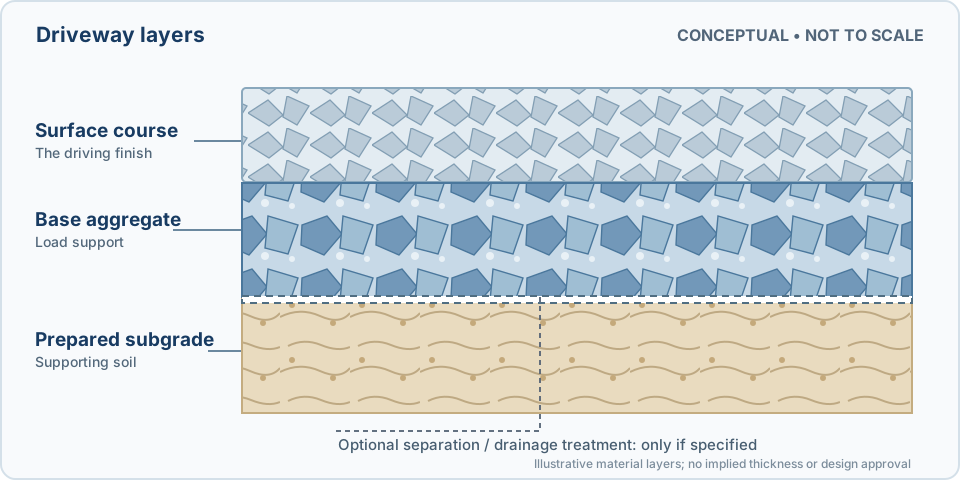
For a gravel-surfaced driveway, the surface itself may be dense-graded stone. For a paved driveway, the wearing course is asphalt or concrete, which creates different base requirements. Do not copy a road or paved-driveway section onto a residential gravel driveway without checking the purpose of each course.
Which crushed limestone is used for a driveway base?
For many conventional, compactable base applications, ask a supplier about a dense-graded aggregate product: angular coarse pieces, smaller particles, and a controlled share of fine particles. Under suitable moisture and compaction, this distribution helps smaller grains fill spaces between larger grains, providing a closely packed aggregate structure. FHWA describes dense grading, angularity, durability, and the presence—but limits—of fines as important base properties.
Common supplier words include dense grade, road base, crusher run, graded aggregate base, or an agency item number. They are useful starting descriptions, not interchangeable specifications. Crusher run can be produced from limestone, granite, or another source rock; it is a product description, not necessarily a different rock from crushed limestone.
When clean stone might appear below a driveway
A designer might specify relatively clean, open-graded stone for a drainage course or part of a foundation improvement. Its open voids can convey water, but open-graded does not automatically mean a tightly compacting, stable finished base. Adequate confinement, separation from fine soil, subgrade support, and a functioning drainage outlet may be required. Simply dumping clean stone into a muddy area may allow soil to migrate into the voids or leave a weak foundation below.
Ask which function the course is supposed to perform: distribute loads, provide drainage, separate soil, or more than one. Those jobs may call for different grading requirements.
Which limestone works as a driveway surface?
The finished surface is a choice between competing priorities:
For a relatively firm driving surface: a locally specified dense-graded crushed-limestone blend can be shaped and compacted. Smaller particles help fill larger voids. Expect some dust in dry weather and a need to shed surface water rather than relying on rapid flow straight through the compacted layer.
For a cleaner, visibly stony surface: screened, relatively open-graded angular limestone may have fewer fines and a more open texture. It can allow water to pass through more readily but may move or scatter under braking, turning wheels, or snow removal. An underlying support layer and edge treatment become important.
For a coarse lower course: large stone can have a function in a site-specific foundation or drainage design, but large angular pieces alone generally do not provide a comfortable final walking and driving texture.
A quarry may recommend a smaller topping aggregate for its local climate and maintenance practices. Request the actual grading sheet and a sample rather than buying exclusively by a familiar number.
Crushed limestone sizes and grades explained
A size designation describes grading; it does not identify the rock chemistry. A construction item number may identify an entire material and installation specification rather than one universal sieve size. Terms like “3/4-inch minus” often indicate a maximum nominal size with smaller material included, but you still need the actual grading limits.
| Material or local designation | What it indicates | Potential driveway role | Main limitation | Specification to check |
|---|---|---|---|---|
| Dense-graded limestone / crusher run | Mixture of coarse and finer crushed particles; actual top size and fines vary | Compacted supporting base; sometimes exposed wearing surface | Fines limit through-drainage; performance depends on grading and compaction | Supplier sieve analysis; project base specification |
| Clean #57 crushed limestone | Typically a screened angular stone-size product with limited fines; verify local grading | Designed drainage course or exposed stone topping over suitable support | Does not form the same dense, bound surface as a graded-with-fines blend; may shift | Applicable state/supplier #57 grading or ASTM/AASHTO designation where specified |
| Larger clean crushed limestone | Coarser, comparatively open stone, exact grading unspecified | Site-designed lower course, separation, or drainage application | Not automatically suitable for soft soil or for an exposed smooth surface | Actual particle-size distribution and construction detail |
| Limestone screenings / stone dust | Predominantly fine crushing product | Component of a graded blend or limited specified leveling work | Not a universal substitute for the structural base or finished course | Supplier gradation and intended use |
| Ohio Item 304 | Ohio DOT aggregate-base construction item, **not** a nationwide stone size | Agency-specified aggregate base, if that specification suits the project | Ask whether your supplier's material meets the applicable Ohio spec and revisions | Ohio Item 304 specification (mirror) |
| Ohio Item 411 | Ohio DOT *stabilized crushed aggregate* course item; not a national #411 sieve class | Specified compacted aggregate course where applicable | Do not assume the number describes one universal limestone blend | Ohio Item 411 specification (mirror) |
| Indiana No. 53 / No. 73 | Indiana DOT identifies different dense-graded compacted aggregate sizes; No. 73 appears as a designated surface choice | Local spec examples showing that base and surface categories differ | Indiana highway rules do not directly prescribe your driveway section | INDOT 2026 specifications, §§303 and 904 |
Don’t equate Ohio’s Item 304 with a 3/4-inch stone size, or assume that every bag labeled #411 has one standardized composition. Where a construction specification controls the project, use its current edition and any supplements. An aggregate might meet a size description but fail a separate requirement for durability, fines, shape, or application.
How drainage and compaction affect your choice
Start with the ground, not the top stone
A soft or waterlogged subgrade may rut even when the aggregate above is strong. Surface water needs a route away from the driving area; water accumulating under or beside it can weaken support. Review whether runoff travels toward a garage, neighbor, drainage ditch, or public right-of-way. On slopes, concentrated water can wash finer particles away.
Fines make a difference—both ways
A balanced range of sizes helps a dense-graded base compact and resist movement. But too many fines, especially plastic or moisture-sensitive fines, can harm bearing performance and reduce permeability. Open-graded clean aggregate often moves water through voids more freely, yet that permeability alone says little about structural suitability. FHWA explicitly distinguishes support, stability, fines content, drainage, and frost response in its granular-base material discussion.
Compaction is a process, not just a product label
Proper placement requires suitable moisture, equipment, lift thickness, and support from the soil underneath. FHWA’s construction guidance identifies poor substrate support, excess moisture, segregation, and incorrect equipment among reasons compaction may fail. “Compacts” on a product listing does not guarantee that a particular driveway will be firm.
If you are planning drains, geotextiles, stabilization, or grading work, ask a local qualified contractor to specify compatible aggregate and separation details. These are functional systems, not products to mix blindly.
How thick should a crushed limestone driveway be?
There is no single layer thickness that fits every driveway. The right section depends on the native soil, existing support, expected cars versus delivery trucks, rainfall, freezing and thawing, topography, selected aggregate, desired finished elevation, and any local driveway or road-entrance requirements. A newly built driveway over weak clay is not equivalent to refreshing an already stable compacted drive.
Before selecting a depth, establish whether the measurement is a loose placed depth or a finished compacted depth. Different materials and construction methods change the relationship. FHWA’s highway compaction examples are useful explanations of principles, not universal residential driveway prescriptions.
For a driveway connecting to a public road, check local access, culvert, drainage, and grading rules. Seek on-site advice for persistent standing water, deep ruts, steep grades, slope instability, or regular heavy vehicle traffic.
How much crushed limestone will you need?
Here is a volume example, not a recommended 4-inch construction design. Imagine a rectangular section measuring 40 ft × 12 ft, with a hypothetical measured layer depth of 4 inches:
- Area = 40 × 12 = 480 square feet.
- Depth in feet = 4 ÷ 12 = 0.3333 feet.
- Volume = 480 × (4 ÷ 12) = 160 cubic feet.
- Volume in cubic yards = 160 ÷ 27 = 5.93 cubic yards.
That figure is the geometric volume at the stated measured depth, not necessarily the quantity of loose aggregate delivered by a truck. To convert it to US short tons, obtain the supplier’s bulk density for this exact gradation and relevant loose/compacted and moisture condition. One US short ton equals 2,000 lb; do not use solid limestone rock density or mistake metric tonnes for US tons.
For multiple sections, supplier quantities, and costs, use the Crushed Limestone Calculator. Enter the actual layer basis and a supplier-confirmed loose-volume conversion if you are specifying compacted thickness. A calculator can estimate quantity; it cannot certify the structural adequacy of the layer.
Buying crushed limestone from a local supplier
Before ordering, tell the supplier whether you need a compacted base, a top course, or a drainage material—and what the driveway is expected to carry. Take this checklist to the counter:
- “What is the exact product name and gradation specification? Can I see a sieve analysis or product sheet?”
- “Is the source stone limestone, or is this crusher-run blend made from another rock?”
- “Is it washed/clean or dense-graded with fines? Is it recommended for the intended driveway layer?”
- “For our local soil and weather, what site preparation and compaction method does your contractor recommend?”
- “What bulk density should I use for ordering, and does it describe loose delivery or compacted in-place material?”
- “Are you selling in US short tons or cubic yards? What are the minimum, increments, delivery fee, and truck access limits?”
- “Does your recommendation require different materials in separate layers, edge confinement, or a drainage/separation design?”
If a supplier says “number 57” or “number 411,” ask for the written state, local, or product specification rather than assuming a nationwide recipe. Compare delivered price using the same sales unit before choosing between quotes.
Crushed limestone driveway problems and common mistakes
| What you notice | Possible contributing issue | Next useful check |
|---|---|---|
| Tires sink or deep ruts persist | Weak/wet subgrade, unsuitable aggregate, or incomplete compaction | Inspect foundation and drainage before topping up |
| Puddles collect | Poor surface fall, trapped water, or blocked outlet | Evaluate grading and safe runoff destination |
| Stone scatters at turns | Loose/open surface without sufficient support or confinement | Check surface gradation, edge control, and traffic pattern |
| Surface gets dusty | High fine-particle exposure in dry use | Ask about alternative grading and maintenance expectations |
| Soft spots return after rain | Poor subsurface support, moisture-sensitive fines, or water entry | Investigate underlying cause; do not just add a thin veneer |
| Order comes up short | Confused loose vs. compacted depth, mixed units, irregular areas | Remeasure and request product-specific density/conversion |
| “The same size” behaves differently | Different gradations, fines, or source properties under one trade name | Compare sieve analyses and supplier specs |
Site preparation often matters more than a nominal product number. Regrading and maintaining drainage can be more effective than repeatedly placing aggregate onto unresolved weak spots. Avoid replacing a genuinely engineered drainage layer with a tight base blend—or using a clean drainage rock as though it will bind like crusher run.
Frequently asked questions
Is #57 limestone the same as crusher run?
Usually not. #57 commonly describes a screened stone-size fraction with limited fines; crusher run commonly describes a range of crushed sizes including finer particles. Confirm both from the supplier, because common trade names vary.
Can I use one limestone product for every driveway layer?
Possibly for a simple, adequately supported section, but not automatically. A designed drainage or separation layer may require a different gradation from a compactable base or wearing surface.
Is crushed limestone good in wet conditions?
It can be part of a suitable design, but limestone alone does not solve wet ground. Drainage location, soil strength, fines, confinement, and freeze–thaw conditions determine what will work. Persistent saturation merits local evaluation before adding stone.
How do I calculate how much to order?
Multiply area in square feet by depth in feet, then divide cubic feet by 27 to obtain cubic yards. For tons, use the supplier’s bulk-density figure and clarify whether you are estimating loose deliveries or compacted in-place volume. Our Crushed Limestone Calculator handles the arithmetic; it does not prescribe a driveway layer design.