Crusher run limestone is a mix of crushed limestone pieces, small chips and fines that can compact into a firm base. Unlike clean, single-size stone, it is deliberately graded across a range of sizes. Suppliers often sell it for driveway bases and other compacted aggregate layers.
Crusher run describes the mix, while limestone describes the rock. Crusher run can be made from other rock types, and some crushed limestone products are clean, screened stone instead.
If you are buying material for a driveway or a pad, first confirm which grade of limestone crusher run the supplier sells and whether it matches your project, rather than ordering by its informal name alone.
What is crusher run limestone made of?
A typical limestone crusher-run product includes three overlapping size groups:
- Larger angular limestone pieces form much of the stone skeleton and help resist movement when properly supported.
- Intermediate chips and smaller particles occupy spaces between the larger pieces.
- Fines, screenings and stone dust can occupy smaller voids, helping a suitable mix compact into a dense layer.
A quarry may sell crusher output with much of its range of particle sizes retained, or it may screen, proportion and recombine aggregate to achieve a specified gradation. The exact method, fines content and maximum particle size depend on the plant and product requirements. A supplier specification or sieve analysis is more reliable than assuming the material is simply unwashed, untouched crusher output.
The FHWA definition of dense-graded aggregate concerns how the distribution of particle sizes produces relatively small void spaces after compaction. It does not say that more dust is always better. Excess or unsuitable fines can harm performance.
Why is it called crusher run?
In quarry and supplier usage, crusher run generally refers to crushed aggregate with a range of coarse-to-fine particles, associated with material coming from a crushing process. You may see it written as crush and run, crush-n-run or crusher-run gravel.
The name is used loosely in retail supply yards. It does not tell you the source rock, exact sieve grading or moisture condition; check the product sheet.
How crusher run works
A suitable dense-graded base works through a combination of angular-particle contact, interlock, particle-size distribution and compaction. During placement and compaction, particles are rearranged and void space can decrease. The small fraction supports a dense arrangement around larger stone, while the larger fraction contributes the aggregate skeleton. Fines do not set like Portland cement just because they become moist.
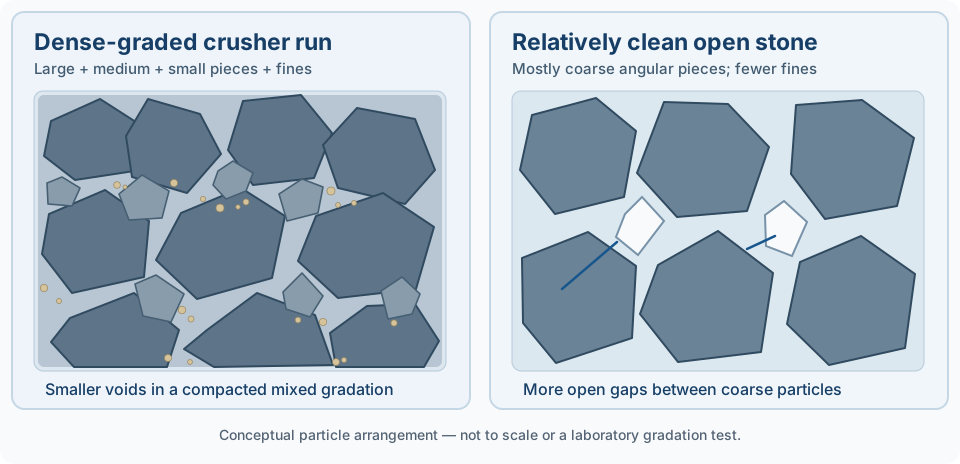
The FHWA granular-base guidance identifies particle shape, gradation, durability, fines and permeability as important and sometimes competing characteristics. Its engineering discussion explains why maximizing compacted density alone does not automatically maximize load-carrying performance.
The ground beneath the stone matters, too. A sound gradation cannot by itself correct soft, wet or poorly prepared subgrade. Placement conditions, moisture, equipment, segregation and required compaction controls influence the final result. FHWA’s pavement-construction manual, Section 8.4.6, discusses these construction variables.
Crusher run sizes and grades
Crusher run comes in multiple sizes. A local supplier might offer a product described as 3/4-inch minus, 1½-inch minus or another nominal top size. “3/4-inch minus” means the mix is intended to include particles passing a roughly 3/4-inch top-size screen down through smaller sizes and fines; it does not mean each stone measures exactly 3/4 inch. Actual sieve tolerances depend on the named specification, and product descriptions can be approximate.
A gradation report lists the percentage by mass passing different sieves. For a serious specification, ask for the full grading requirements and test results, including how much passes the fine No. 200 sieve where relevant.
| Description seen when buying | What it tells you | What it does not establish |
|---|---|---|
| Limestone crusher run | Limestone source rock; graded crushed product with fines | Fixed top size, measured density or fines percentage |
| 3/4-inch minus | Approximate top-size category with smaller material included | A single national sieve curve or guaranteed drainage |
| Dense-graded aggregate (DGA) | Gradation intended to compact with relatively small voids | One universal blend or single source rock |
| Quarry process / QP | Common local trade name for graded crushed aggregate | That it satisfies a specific agency standard |
| Road base / aggregate base | Intended function in a pavement or access-road system | That every item sold under the name is equivalent |
| #304, #411, ABC, GAB, 21A | Names or specification identifiers encountered regionally | Nationwide equivalence across states or suppliers |
| #57 clean limestone | A typically more uniform, relatively low-fines crushed aggregate category | That it is a crusher-run substitute or an identical grading everywhere |
An example of why names matter: Ohio DOT distinguishes Item 304 Aggregate Base and Item 411 Stabilized Crushed Aggregate in its Construction & Material Specifications. The DOT’s Location & Design Manual refers to them as separately designated alternatives in certain pavement designs. That does not prove that a merchant’s generic “#411” or “crusher run” meets an Ohio DOT item, much less a specification in another state.
The public ASTM D448 classification summary likewise describes standard aggregate size designations and sieve ranges; it is not a specification for every product advertised as crusher run. Check the local governing requirement instead of relying on a size-number nickname.
Is crusher run the same as crushed limestone?
No. The two terms describe different things and can overlap.
- Crushed limestone says what the stone is made from and that it has been crushed. It could be clean, narrowly graded stone, dust, screenings or a dense-graded mix.
- Crusher run identifies a coarse-to-fine crushed aggregate product commonly used where a compactable layer is wanted. Its source rock may be limestone, granite or something else.
- Crusher run limestone is the overlap: limestone source rock supplied as crusher run.
For example, a quarry could sell clean #57 limestone for a drain and also offer a limestone crusher-run base containing smaller chips and fines. Ordering simply “crushed limestone” would not distinguish those two products.
Crusher run vs #57 limestone
A clean #57 limestone product and a limestone crusher-run blend can have different gradations even when both are made at the same quarry.
| Buying question | Limestone crusher run | Clean #57 limestone |
|---|---|---|
| Size distribution | Broad mix from coarser fragments into fines | More restricted coarse-aggregate size range |
| Fines | Usually deliberately present | Typically limited, especially if sold as washed/clean |
| Compacted behavior | Can form a denser, relatively stable base if properly graded and placed | Coarse particles can settle and rearrange; does not make the same fines-filled dense matrix |
| Through-layer water flow | Often less permeable than an otherwise comparable clean open mix | Often offers more connected void space for flow |
| Common selection reason | Specified compactable aggregate base | Specified clean aggregate, drainage layers or surface stone |
| Must verify | Top size, sieve curve, plasticity/quality, compaction requirements | Exact #57 grading, cleanliness, filtration and suitability |
Neither product wins every project. Clean #57 can have valuable drainage characteristics, while dense-graded crusher run can be preferable for a designed compacted base. A #57 product is not guaranteed to solve a soft-subgrade problem, and dense-graded stone is not automatically the correct base beneath every paver or slab. Ask which material the project specification actually requires.
Crusher run vs drain rock
Drain rock describes aggregate selected for a water-handling function; properly chosen drain rock is generally relatively open graded and low in fines. Crusher run usually contains enough fine material to make through-layer drainage less favorable than clean open stone, although the actual difference depends on gradation, contamination and surrounding conditions.
For a French drain or permeable base, the objective is not just to have spaces between stones: the design may also require soil/filter compatibility, a geotextile or graded filter, pipe details and a functioning outlet or infiltration path. FHWA warns that introduced fines can compromise a permeable base (Chapter 8, Section 8.4.7). Dense-graded crusher run should not be substituted for specified drainage stone without approval.
Also distinguish surface runoff from water passing through the stone. A compacted surface can shed water across its top while the aggregate beneath still admits some water. Neither behavior means that the layer is waterproof.
Crusher run vs pea gravel
Crusher-run aggregate commonly contains angular crushed pieces plus smaller graded particles; pea gravel is typically a smaller, more rounded aggregate sold for appearance and selected landscape uses. Rounded particles are less mechanically interlocking than angular particles under otherwise comparable conditions. Pea gravel may move more freely at the surface; crusher run can form a tighter layer under suitable compaction.
But grading, confinement, subgrade and use still matter. Neither is an automatic substitute for the other in an engineered base or drainage detail. Compare the actual supplier materials, not just their generic names.
Where is crusher run used?
The following are common candidate uses, not universal approvals:
- Driveway base layers: A specified dense-graded aggregate may provide a compacted supporting layer beneath the wearing surface. Soil condition, drainage and expected vehicle loads govern the design.
- Private access roads and selected roadway bases: Road-building guidance supports graded aggregate bases, subject to the jurisdiction’s material and compaction specification.
- Equipment or utility pads: It can be considered as a compacted base where the design calls for granular support; expected loads and subgrade bearing behavior require separate evaluation.
- Under some paved surfaces: Certain patio, asphalt and concrete systems may call for compactable aggregate base, but proprietary paver and permeable-pavement systems may specify different materials.
- Leveling and selected landscape bases: A fines-containing product may be useful where the job calls for a graded, compactable layer, but it is not a substitute for specified free-draining backfill.
Do not assume a product suitable for a driveway is therefore suitable for drainage trenches, retaining-wall backfill or every patio design.
Is crusher run good for driveways?
It can be a good driveway base when the selected material matches the driveway design. Angular stone and an appropriate spread of sizes can help create a stable compacted layer; the result still depends on drainage management, soil support and proper construction.
Consider five questions: Is the underlying soil firm and prepared? Does water have somewhere to go? Is the crusher-run grade correct for the planned layer? Can the intended equipment compact it effectively? Will the surface be left exposed to traffic and weather, or covered by another specified material?
Fines-containing surfaces may become dusty in dry weather, track fines or need periodic reshaping under repeated traffic. A surface gravel system has maintenance needs that a hidden compacted base may not. Choose the full system—subgrade, base, surface and drainage—not one bag or pile of rock in isolation.
Does crusher run drain water?
Some water can travel through crusher run, but a dense-graded mix is not normally chosen just because maximum drainage is needed. The small particles that help fill voids can also reduce connected pathways for water, particularly compared with a properly clean, open-graded aggregate.
Actual drainage depends on gradation, how much fines are present, compaction, moisture, clogging and the neighboring soil. Even a clean drain layer can become ineffective if sediment enters it. FHWA distinguishes between dense-graded bases and drainage layers with more controlled fines and hydraulic behavior.
If the goal is a French drain, footing drain or specified permeable base, ask for a drainage-appropriate aggregate and filter detail rather than assuming that “gravel” on the delivery ticket is sufficient.
Does crusher run compact?
Yes—an appropriately graded crusher-run product is commonly selected because it can be compacted into a dense base. “Compacts well” is not a promise of one final density, strength or percentage of depth reduction.
Moisture condition, particle breakdown, segregation, layer thickness, equipment type and underlying support can materially change results. Excessive moisture or inadequate subgrade support can prevent good compaction. Fines are not cement, and adding more fine dust is not a shortcut to better engineering performance.
For ordering calculations, keep these three different measurements separate: finished compacted volume, delivered loose bulk volume and mass. Compacted bulk density, loose bulk density and solid-rock particle density are different quantities.
How much crusher run do you need?
First calculate the finished geometric volume of the layer. For a hypothetical rectangular driveway section 30 feet long, 12 feet wide and 4 inches finished depth:
- Area = 30 × 12 = 360 square feet.
- Finished volume = 360 × (4 ÷ 12) = 120 cubic feet.
- Cubic yards = 120 ÷ 27 = 4.44 cubic yards (rounded).
The 4-inch depth is only an arithmetic example, not a recommended installation thickness. 4.44 cubic yards is finished geometric volume, not automatically 4.44 loose delivered yards. To calculate tons, you need an appropriate supplier-confirmed density for that volume state; to order by loose yards, you need a valid loose-to-finished conversion. Neither a fixed tons-per-yard number nor a blanket compaction percentage applies nationally.
Once you have selected the actual product, use the Crusher Run Calculator to distinguish compacted volume, supplier density, ordering increments and delivered quantities.
How to choose crusher run from a supplier
Use this list when requesting a quote or picking up material:
- Rock and product: “Is this limestone crusher run, or another source rock? What is the exact stockpile name?”
- Grading: “What is the nominal top size, sieve distribution and fines content? Is a current gradation sheet available?”
- Specification: “Does this stockpile meet the exact state DOT, county, contractor or manufacturer specification written on my plans?”
- Job fit: “Is it intended for a compacted driveway base, a wearing course or a specific surface system? Is this material unsuitable for any required drainage layer?”
- Quantity basis: “Do your density figures refer to loose bulk, compacted bulk or another condition? Is the material sold by US short ton (2,000 pounds) or by loose cubic yard?”
- Quote: “What is the material price per US short ton or loose cubic yard? What are minimums, rounding increments, fuel/delivery fees and additional unloading charges?”
- Delivery: “Is the product available now? What are the truck’s load limits and access/turnaround requirements at my site?”
If the supplier cannot provide an engineering specification, treat the product as a locally described material, not as automatically certified DOT-grade aggregate.
Common crusher run mistakes
- Assuming all crusher run is limestone: the same material category can use different source rocks.
- Treating local names as universal codes: “#411,” “21A,” “ABC” and “road base” need location-specific verification.
- Confusing clean crushed limestone with crusher run: two limestone piles may behave differently because of fines.
- Replacing specified drain rock with crusher run: dense-graded products and free-draining systems have different objectives.
- Ignoring wet or weak subgrade: aggregate grading cannot compensate for every foundation problem.
- Adding a universal 10–20% compaction allowance: supplier measurements and layer state determine the conversion.
- Using solid limestone density for truckloads: rock-particle density is not loose or compacted bulk density.
- Mixing units: a US short ton is weight; a cubic yard is volume; they need an applicable bulk density to convert.
- Budgeting only for stone price: minimum orders, freight, delivery access and handling can change the total.
Frequently asked questions
What does 3/4-inch minus mean?
A nominal size description for a mix containing particles from approximately a 3/4-inch top-size category down to smaller fragments and fines. Confirm the permitted oversize and sieve limits on the exact product sheet.
Is crusher run the same as #411?
Not necessarily. #411 can refer to different local supplier products and an Ohio DOT item, but the names do not define one nationwide, interchangeable grading. Check the intended jurisdiction and specification.
Does crusher run drain water?
It can pass some water but is usually less free-draining than a suitably clean, open-graded stone. It is not waterproof, and it is not automatically an acceptable drainage aggregate.
Is crusher run suitable for a French drain?
Do not assume so. Use the specified clean, drainage-compatible stone and appropriate filter, pipe and outlet arrangement. A typical fines-containing crusher run is not the default substitute.
How many tons of crusher run do I need?
Measure the finished volume and then use a supplier-confirmed bulk density or verified loose-to-compacted conversion for the material state. A universal tons-per-cubic-yard factor is unreliable.
Is crusher run cheaper than clean crushed stone?
There is no dependable nationwide price ranking. Local quarry supply, grading, haul distance, order minimum and delivery charges can outweigh the difference in quoted unit prices.
Before buying: match the quarry’s gradation to your project, then estimate quantity using the Crusher Run Calculator.