Drain rock is gravel or crushed stone chosen to let water move through a trench or drainage layer. It usually contains relatively few fine particles, leaving connected spaces between the stones. The name doesn’t specify one rock type or one nationwide stone size.
When buying drain rock, check gradation (the mix of particle sizes), fines and compatibility with nearby soil. Limestone, granite and rounded gravel can all be suitable in the right design. The rock also needs an effective outlet or infiltration path—clean stone alone won’t fix a poorly drained site.
What is drainage rock made of?
Drain rock may be made from crushed quarry stone (such as limestone or granite) or naturally rounded gravel recovered from local deposits. Crushing generally produces angular faces; naturally rounded material tends to have smoother particles. Shape can affect handling and stability, but neither shape alone proves a product will drain adequately.
The gradation—the distribution of particle sizes—is usually more important to this decision than whether the stone is limestone or granite. Two products labeled “limestone,” for example, may have very different amounts of small particles. An appropriately graded, durable stone can be suitable for a defined drainage purpose regardless of its underlying source rock.
Some suppliers sell “3/4-inch clean,” “drain rock,” “washed #57,” “screened rock” or a local numbered aggregate. These labels are useful questions to ask, not substitutes for a sieve-analysis sheet or the project’s specified gradation. The publicly available ASTM D448 classification summary also shows why aggregate size-number designations belong to defined grading systems, rather than being national recipes for all residential drains.
How does drainage rock work?
Water can pass through interconnected voids between aggregate particles. A relatively open gradation with limited fines often preserves more flow space than a dense blend in which small particles fill the gaps. As the FHWA’s granular-base guidance explains, grading affects the material’s stability and permeability.
However, three separate jobs are often confused:
- Convey water: sufficiently connected voids offer a path through the rock.
- Protect against soil movement: a correctly matched graded filter or engineered geotextile can restrict soil particles entering the voids while permitting water through.
- Take water somewhere useful: an outlet, collection line or infiltration area needs to function under local site conditions and applicable rules.
Large gaps do not automatically make a good soil filter. If a fine soil is placed directly against coarse rock, particles may move into the open spaces, reduce flow capacity, and cause settlement. This is why the NDS exterior drainage manual, Chapter 3 distinguishes the gravel or stone envelope around a pipe from the filter that limits soil migration. FHWA similarly warns that construction dirt and adjacent fines can contaminate drainage layers.
Open-graded versus dense-graded: a useful mental picture
Think of a jar filled with similarly sized stones: open spaces remain between the pieces. Now add progressively smaller pieces and dust: those gaps become partly occupied. This describes gradation, not a field permeability test. Compaction, particle shape, segregation, soil conditions and material specifications still matter. The Clermont Soil and Water Conservation District’s fact sheet explains this difference for local conservation projects.
Common drainage rock types
| Material category | What to expect | Possible use | What to verify |
|---|---|---|---|
| Washed crushed stone | Angular coarse aggregate rinsed to reduce loose dust and fine particles | Specified pipe envelopes, drainable layers and selected backfill | Actual grading, retained fines, durability and soil/filter compatibility; see Clermont SWCD |
| Clean rounded gravel | Naturally rounded particles with relatively low fines where supplied as a clean grade | Selected stone-filled trenches or beds where the design permits its shape and grading | Screening/washing condition, grading and required stability; see NDS, Ch. 3 |
| Specified open-graded aggregate | Controlled particle-size distribution intended to preserve connected voids | Engineered drainable layers, underdrains or designated backfill | Governing design, fines limits, strength and filtration; see FHWA, §8.4.7 |
| Dense-graded stone / crusher run | Coarse, intermediate and small particles, often including fines, selected for compaction | Compacted road, driveway or equipment-support base where specified | Usually not a direct substitute for free-draining rock; see FHWA granular base |
| Supplier-named drain rock | A local named product whose rock type, shape, washing and grading may vary | Only uses supported by its actual specification | Written gradation and intended application, not the marketing name alone |
A supplier may offer multiple grades in each category. Do not substitute a “closest-looking” pile when a project drawing identifies a particular gradation or filter layer.
Drain rock vs. gravel: what’s the difference?
Gravel is a broad word for naturally occurring coarse fragments and, in everyday supply-yard language, various crushed aggregates. Drainage rock describes aggregate intended for a water-management function. As a result, some drain rock is gravel, and crushed stone can also be sold as drain rock. The terms overlap rather than identify two mutually exclusive minerals.
For purchasing, ask for the actual product: its crushed or rounded shape, gradation, whether fines have been removed and which drainage application the supplier recommends. A generic bag labeled “gravel” is not enough information for a designed pipe envelope or infiltration bed.
Drainage rock vs. crusher run
Crusher run is commonly a dense-graded crushed aggregate containing a mix of coarse particles and smaller material, sometimes extending to rock dust. The smaller particles help the mixture pack together for a compacted base. That is useful when the main task is supporting a driveway; it can be undesirable where a drainage design explicitly calls for interconnected open voids.
| Feature | Drain rock chosen for free drainage | Typical crusher run / compacted base |
|---|---|---|
| Grading | Relatively open, with controlled low fines | Broad range of sizes with smaller particles |
| Compaction | Voids are intentionally preserved; requires appropriate confinement and design | Often selected to compact into a stable, close-packed layer |
| Water movement | Potentially more free draining if design and grading are right | Often less permeable; do not use as an assumed drainable layer |
| Common purpose | Pipe envelope, drainage bed or specified backfill | Driveway base, road base or other compacted load-supporting work |
| Selection rule | Confirm hydraulic and filtration needs | Confirm load-bearing, grading and compaction needs |
Neither name guarantees a specific fines percentage nationwide. The FHWA construction manual, §8.4.7 emphasizes both appropriate grading and protection against contamination for drainable layers. A crushed-stone product could be manufactured as either a clean drainage grade or a dense-graded base, depending on processing.
Washed drain rock vs. unwashed stone
Washed normally indicates that aggregate has gone through a water-cleaning process intended to remove adhered dust and fine particles. Screened means that a sieve or screen separates particle-size fractions; depending on the equipment and product, some fine dust may remain. Clean is a supplier description for comparatively low-fines material, but it is not automatically proof of a particular washing method or gradation.
An unwashed material may carry more quarry dust, clay or other fine particles. Those fines can occupy aggregate voids and reduce drainage capacity. The Clermont SWCD fact sheet, p. 1 distinguishes washed, unwashed and clean stone for its regional practice guidance.
The purchasing lesson is simple: ask what the supplier actually guarantees. “Washed” does not prove correct sieve sizes, allowable fines, filter compatibility or compliance with a site design. “Screened” does not mean every dust particle is gone, and a visibly clean sample is not a substitute for the relevant specification.
What size rock is used for drainage?
There is no one best diameter for every French drain, infiltration system or pipe trench. Product numbers, nominal sizes and local names are often shorthand for a range of stone sizes. Choosing by a single number while ignoring fines, pipe geometry and adjacent soil is unreliable.
Before selecting a grade, check:
- System type: an aggregate-only trench, pipe envelope, drainable bedding course, retaining-wall drainage zone and engineered infiltration bed can have different requirements.
- Local specification: the drawing, agency requirement or manufacturer’s installation instructions may identify a precise grading.
- Soil and filtration: the adjacent soil can lose fines into an over-open material unless a suitable filter or separation arrangement is designed.
- Pipe details: bedding, pipe wall stiffness and perforation or slot geometry may constrain the acceptable aggregate.
- Hydraulics and outlet: flow demand, grade and discharge arrangement affect the system, not just the rock’s nominal size.
As a regional example, not a nationwide rule, Clermont SWCD in Ohio identifies its local No. 57 and No. 67 materials as useful for certain drainage fill around pipes, contrasting them with compacting No. 304 and No. 411 materials. Those names and ranges should not be transplanted into another jurisdiction without checking its actual material schedule.
Where is drainage rock used?
French drains and other subsurface trenches. A selected aggregate envelope provides a place for water to move toward a collection point or pipe. Filtration and lawful discharge remain separate design needs.
Perforated pipe bedding and backfill. Properly specified stone may support and surround pipe while allowing water to enter it. Pipe manufacturers and project drawings can impose additional bedding and size constraints.
Drainage beds and drainable layers. Open-graded aggregate can form part of a designed drainage layer, provided it is protected from fine soil and properly connected to the overall drainage path.
Retaining-wall drainage systems. Selected aggregate or a purpose-made drainage product may reduce water accumulation behind a wall, but wall stability, waterproofing, outlets and loads need a proper wall design. Do not assume adding rock makes an unsafe wall safe.
Specified infiltration facilities. Washed aggregate may be used in some stormwater facilities to store or convey water, but these systems depend on infiltration testing, local criteria, contamination controls and permits.
The NDS exterior drainage guide documents French-drain stone envelopes. The FHWA pavement guidance documents carefully graded drainage backfill and outlets for roadway systems. Neither is a universal residential construction blueprint.
What rock is used around a French drain pipe?
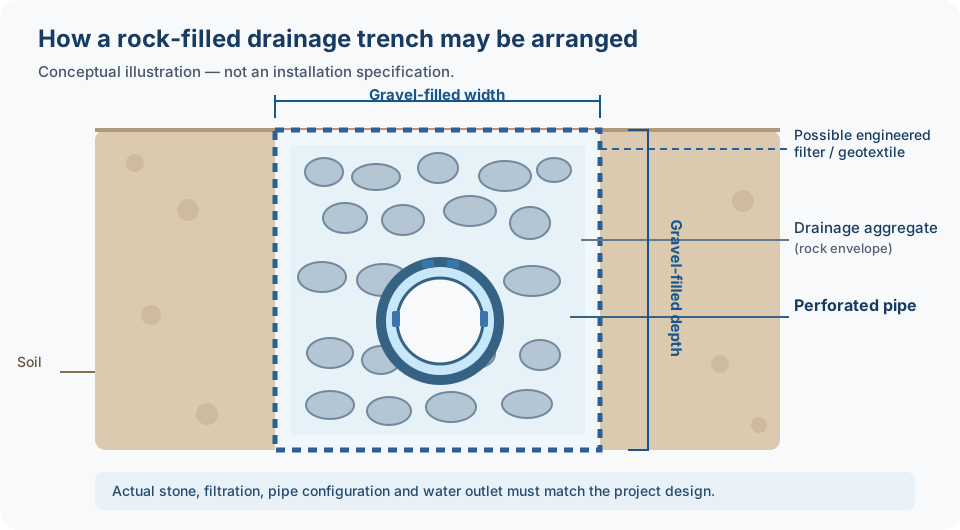
A pipe surrounded by a gravel or stone envelope can receive water from nearby soil and direct it into a collection pipe. In the NDS manual’s Chapter 3, the envelope’s role is described separately from the filter’s role. Around the pipe, the material must satisfy several requirements at once:
- Gradation: enough connected voids for the intended water movement, while satisfying the drainage detail.
- Condition: acceptable fines content and no contamination during placement.
- Bedding: appropriate support and backfill for the actual pipe, including manufacturer requirements.
- Filter interface: a graded filter or selected geotextile where needed to control fine-soil migration.
- Functional destination: an outlet, connected system or properly evaluated infiltration area.
Perforations should not be treated as a universal rock-size sieve. Their geometry varies by pipe product. Follow the specified pipe-and-aggregate assembly rather than pairing a random clean rock with a random pipe. A perforated pipe is not required in every aggregate-filled drainage application, but its omission changes how water is collected, conveyed and maintained.
Does drainage rock need landscape fabric?
Sometimes a geotextile filter or separator is needed; ordinary landscape weed-barrier fabric is not automatically suitable. The engineering question is whether material at the soil–aggregate interface can let water pass while retaining soil under the expected conditions. A filter fabric is selected by opening size, permeability/permittivity, clogging resistance and durability—not simply by a retail “landscape fabric” label.
The FHWA Ground Modification Methods manual, Volume II, §8.3.2.1 discusses checking geotextile filtration against the adjacent soil’s gradation and permeability. The NDS manual, pp. 15–16 describes both geotextile and granular filter materials.
A geotextile can also clog or perform poorly if it is mismatched to the soil. Nonwoven fabrics are common in certain subdrains, but no single fabric type or “wrap everything” detail fits all sites. Where the soil is very fine, the drain protects a building, the site has ongoing seepage, or a municipal stormwater detail applies, use the relevant design and a qualified professional rather than a generic landscape roll.
How much drainage rock do I need?
For a hypothetical rectangular stone-filled trench 40 feet long, 12 inches wide and 12 inches deep within the gravel envelope:
40 ft × (12 ÷ 12) ft × (12 ÷ 12) ft = 40 cubic feet, or 40 ÷ 27 ≈ 1.48 cubic yards.
This is the gross rectangular envelope volume, not a promise of the amount to order. If a pipe occupies part of the modeled gravel space, use its actual outside dimensions to evaluate displacement. Changes in trench shape, loose bulk density, purchase increments and allowance also matter. Converting cubic yards to US short tons requires an applicable supplier-specific loose bulk density; there is no universal drain-rock tons-per-yard factor.
Use the Drain Rock Calculator to estimate cubic yards, pipe displacement and supplier-based tonnage
What to ask before buying drain rock
Before buying by the yard or by the US short ton, bring this short checklist to the quarry or landscape supply yard:
- What exact product and specification is this? Request a product sheet or gradation/sieve analysis, not only a pile name.
- How much fine material does it contain? Ask whether the stone is washed, screened or supplied as a defined clean grade, and what that means at this yard.
- Is this grade approved for my particular drainage detail? Ask about the system’s soil, any pipe, bedding and any prescribed filtration layer.
- Does my pipe or geotextile manufacturer specify an aggregate grading? Compare the actual document before ordering.
- What loose bulk density applies? Confirm units (lb/yd³ or US short tons/yd³), any moisture assumptions and whether material is sold by volume or weighed tons.
- What is the delivery quantity and total landed cost? Check price per unit, minimum load, rounding increments, delivery charges, truck access and unloading location.
For engineered infiltration facilities, retaining walls, foundations and other consequential work, confirm the approved design and local discharge rules before choosing aggregate.
Common drainage rock mistakes
- Using crusher run for a specified free-draining course. A compactable blend with fines has a different purpose.
- Believing bigger stone is always a better filter. Wider voids may admit more fine soil if the interface is unprotected.
- Ignoring the soil beside the trench. Fine soil can migrate into open stone and reduce its performance.
- Treating “washed,” “screened,” “clean,” “#57” and “drain rock” as synonyms. Supplier terminology and grading vary.
- Treating drainage rock as a structural base without checking stability. Open stone and densely compacted base can behave differently.
- Ordering tons from a fixed yards-to-tons conversion. Ask for the selected material’s loose bulk density.
- Ignoring pipe displacement. A pipe may occupy some of the geometric gravel envelope.
- Substituting weed barrier for specified filter fabric. A proper filter depends on soil retention and hydraulic criteria.
- Buying stone before establishing a water destination. No aggregate grade makes an inadequate outlet or unlawful discharge acceptable.
Frequently asked questions
Is crushed limestone suitable for drainage?
It can be, when the limestone is durable and supplied in a grade that meets the project’s requirements. Limestone source rock alone does not guarantee permeability or filtration compatibility.
Does drain rock have to be washed?
A project might explicitly require washed material; another may specify gradation and cleanliness without that exact production process. “Washed” reduces dust but does not replace all other acceptance criteria.
Can pea gravel be used for drainage?
Some correctly graded, clean rounded pea gravel products may suit a particular design. Others may be too mobile, too small, or unsuitable for the filter or pipe. The label alone is not an approval.
Does drainage rock need fabric?
Not in every system. A geotextile or granular filter may be required depending on surrounding soil and the design. Weed-barrier material is not a universal substitute.
How do I estimate drainage rock in cubic yards?
For a rectangular rock-filled space, multiply length × width × gravel-filled depth using feet, then divide cubic feet by 27. Consider pipe displacement and actual purchase units separately.
Does drainage rock work without a pipe?
An aggregate-filled trench or bed may allow local water movement without a pipe, but whether it effectively collects, conveys or infiltrates water depends on the actual site and system design.
Next step: check the drain’s required grading, filter and outlet, then estimate the specified rock with the Drain Rock Calculator.