A French drain usually needs clean, low-fines aggregate that lets water reach the pipe. Washed gravel or crushed stone may work, but the right size depends on the pipe, surrounding soil and filter arrangement. Choose the rock for the drainage system—not just because the yard calls it “drain gravel.”
You may see products sold as “washed #57 stone,” “¾-inch clean crushed stone” or “drain rock.” Ask for their grading and fines content. The NDS exterior drainage guide also explains why the stone envelope that carries water and the filter that keeps soil out are different parts of the job.
What kind of rock goes in a French drain?
A conventional piped French drain includes a water-conducting aggregate envelope around a perforated pipe. “Drain rock” can be crushed limestone, granite, another suitably durable crushed stone or naturally rounded gravel. The source rock is not the specification: the meaningful attributes are size distribution (gradation), fines content, cleanliness, shape, durability and compatibility with the rest of the system.
- Clean crushed stone: angular aggregate manufactured in a relatively open grading, with limited dust and fine particles.
- Washed gravel: rock cleaned to reduce loose fines. It may be naturally rounded or crushed; “washed” alone does not establish a particular size.
- Supplier-specific drain rock: a local product name that needs a written size range or gradation description.
- Specified open-graded aggregate: material selected against a defined grading or drainage requirement rather than an informal label.
Ask about the entire product, not its largest visible stones. Fine dust or silt can occupy spaces between rock particles and interfere with free drainage. A supply-yard photograph cannot establish the amount passing a small sieve. For the broader meaning of drain rock across landscaping and other uses, see What Is Drainage Rock?; this guide is specifically about choosing material for a French drain.
Why French drains use gravel or stone
An aggregate envelope provides connected spaces through which groundwater can reach the drainage pipe. It can also provide bedding and support around the pipe when the installation instructions permit that material. Water enters the aggregate, passes through the pipe’s perforations or slots, and is then conveyed toward an appropriate outlet in a conventional piped system.
There are three different jobs here:
- Conveyance: the rock envelope needs connected voids, and the pipe or stone trench must have a workable discharge route.
- Filtration: native soil must be prevented from washing into the envelope or pipe to an unacceptable degree. Properly designed granular filters or geotextiles can perform this function.
- Structural compatibility: the stone must also suit the pipe’s allowable bedding, cover and support requirements.
Coarse rock by itself is not necessarily a soil filter. Soil particles can migrate into large gaps if the adjacent soils and filter layers are incompatible. NDS discusses both separate filters and aggregate envelopes in its manual, while FHWA’s pavement-drainage design guidance treats filtration, flow and survivability as separate design checks. Highway requirements illustrate the engineering principles; they are not a universal backyard recipe.
Best rock types for a French drain
There is no unconditional winner. Compare products by the characteristics they can document, then match one to the system design.
| Material | Characteristics | Potential use | Limitation | Ask the supplier |
|---|---|---|---|---|
| Clean angular crushed stone | Crushed faces; may have an open, low-fines grading | Pipe envelope where its size, stability and grading are approved | “Crushed” does not mean washed or free of fines | Actual sieve gradation and fines content? |
| Washed rounded gravel | Rounded particles; washing can reduce dust and silt | Trenches or beds permitting this material and pipe bedding behavior | Round shape alone proves neither flow capacity nor filter compatibility | Size range, washing, and suitability near this pipe? |
| Specified open-graded aggregate | Defined particle-size distribution, usually limited fines | Drainage envelopes or engineered systems calling for that grade | Grading still must fit soil, pipe and load conditions | What standard, revision and test report apply? |
| Dense-graded crusher run | Blend of large and small particles, often including rock dust; selected for compaction | Compacted base applications, not a presumed open drainage envelope | Fines can reduce interconnected voids; not a direct substitute without approval | Is this a dense base mix or an actual drainage grade? |
| Pea gravel | Small rounded gravel; size and fines vary by supplier | Only an assembly whose gradation, filtration and stability allow it | May not meet the bedding, filter or particle-size criteria | Washed? Actual sieve distribution? Explicitly permitted? |
| Unverified mixed fill or bank-run gravel | Variable gradation and possible sand, silt or clay | Not a defensible substitute for a specified drainage aggregate | Unknown fines and inconsistent material | Can you supply a written test or specification? |
A limestone product is not automatically inferior to granite; a round gravel is not automatically superior to crushed stone. Particle shape can influence how material beds and interlocks, but the drainage decision requires more than shape. FHWA describes open-graded aggregate by specified size distributions, not by one universal source rock.
What size rock is used for a French drain?
Read a size designation as a grading description, not a measurement of every particle. A product described as “¾-inch stone” can include particles both larger and smaller than ¾ inch, depending on its grading standard. Its largest nominal size and the percentage of smaller material are both relevant.
Two documented residential approaches show why a nationwide prescription would be misleading:
- US Fabrics’ backyard French drain guide, p. 2, lists ¾-inch washed stone alongside a 4-inch perforated PVC pipe and filtration geotextile. It explicitly defers to project-engineer instructions where they conflict.
- DOE Building America’s stormwater site-drainage guide describes clean rock from ¾ to 2 inches in a particular French drain example. Its trench dimensions, pipe and wrap are one documented configuration, not a universal minimum or grading requirement.
Before selecting a size, confirm the following:
Gradation: Ask for a sieve analysis or written grading range, not only a “¾-inch” label. Coarse stones with substantial fine dust behave differently from a clean, controlled product.
Pipe openings and bedding: Different corrugated and smooth-wall products use different perforation or slot patterns. Ask the pipe manufacturer what bedding gradation, stone contact and cover are permitted. An apparently suitable rock size can still be wrong for a particular pipe or its surrounding filter.
Native soil: The finer the adjacent soil and the more sensitive the site, the more important retaining soil without prematurely blinding or clogging the filter becomes. Coarse rock is not a replacement for this check.
System function: Yard interceptor drains, basement-adjacent foundation systems, road underdrains and infiltration beds can have different standards. An approved construction drawing overrides a generic web article.
Is #57 stone suitable for French drains?
It can be a candidate when clean and approved for the particular drain assembly, but #57 stone is not a nationally mandated French-drain product.
Under the AASHTO M43-05 size designation reproduced in FHWA-HRT-13-068, Table 1, No. 57 has these selected percent-passing limits:
| Sieve opening | Material passing (by mass) |
|---|---|
| 1½ inches | 100% |
| 1 inch | 95–100% |
| ½ inch | 25–60% |
| No. 4 (about 4.75 mm) | 0–10% |
| No. 8 (about 2.36 mm) | 0–5% |
This means a No. 57 stockpile contains a distribution of particle sizes. The FHWA table does not certify that a particular yard’s stone is clean, meets the project’s current specification or works with its perforated pipe. Some regional products labeled #57 may follow amended specifications or have different quality controls. Obtain the supplier’s actual designation, source and test information before substituting it for a designed aggregate.
Washed gravel vs. crushed stone for French drains
These labels answer different questions. “Washed” describes processing intended to remove loose fine particles. “Crushed” describes how angular stone is produced. You can buy washed crushed stone, washed rounded gravel or unwashed crushed stone; the first two terms do not compete as mutually exclusive product categories.
Crushed stone may have interlocking angular faces, while rounded gravel has smoother contacts. Both can form interconnected voids if graded appropriately. The ability to drain does not follow from roundness or angularity alone. Check stone distribution and fines, the bedding support required for the pipe, and the filter design. Also distinguish screened material from washed material: screening separates size fractions but does not by itself prove that adhered dust has been removed.
A supplier who can produce the gradation and explain where the material is used is more helpful than one who only says it is “great for drainage.”
Can you use pea gravel in a French drain?
Sometimes a pea-gravel product may fit a particular design; it should not be treated as a universal yes—or a universal no. “Pea gravel” often describes relatively small rounded particles, but actual ranges and cleanliness differ. Its small sizes may be acceptable in some filter or drain assemblies and unsuitable in others.
Check the pipe manufacturer’s bedding requirements, soil/filter compatibility and a written grading before considering it. Do not assume a clean, rounded product must drain poorly solely because it is round. Equally, do not assume a decorative bag of small pebbles is compliant with an engineered drainage design.
Why crusher run is usually not a direct substitute for drain rock
Ordinary crusher run is normally a dense-graded aggregate base: coarse particles are blended with smaller pieces and fines so the material can compact into a stable surface. A free-draining pipe envelope ordinarily depends on a different particle-size distribution, with enough connected open space to allow water to move.
FHWA’s pavement discussion, §§7.2.3 and 7.2.7, distinguishes slow-draining dense-graded bases from permeable aggregate layers and warns that fines can severely reduce permeability. Its numerical values concern pavement materials, so they should not be treated as the predicted performance of your residential trench.
A product labeled “crushed stone” could be suitable in an open clean grade. A product labeled “crusher run” should not be swapped into a specified drain-rock envelope without a clear grading and approval. Choosing a compactable driveway base and choosing a free-draining pipe surround are fundamentally different purchasing tasks.
How the rock envelope works around a perforated pipe
The conceptual drawing below shows the roles of the rock and optional soil/aggregate filter interface, not a direction to put a pipe at a fixed height or orient every manufacturer’s holes the same way.
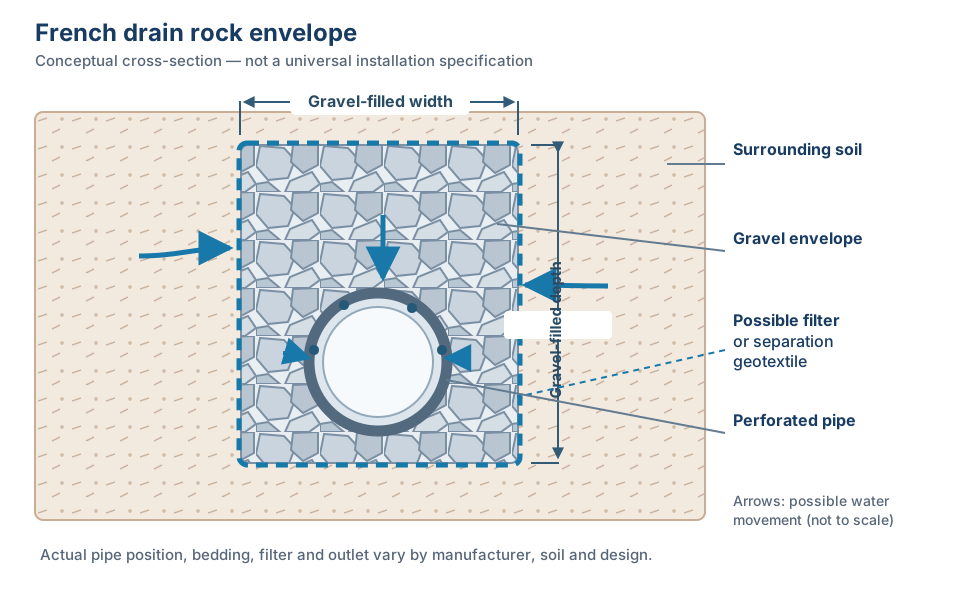
The pipe’s outside diameter matters when calculating stone quantity. A nominal “4-inch” pipe may have a different actual outside diameter, and its perforations may be slits distributed around a corrugated pipe or hole rows in another product. NDS makes this distinction in Chapter 3, p. 15.
A clean envelope conveys water to the pipe, but if adjacent soil migrates into those voids it can compromise the system. The filter interface, feasible outlet and ongoing maintenance matter as much as the original stone. No drawing of “gravel around a pipe” alone guarantees the site will drain.
Does a French drain need geotextile fabric?
Many documented designs use a properly chosen geotextile, but the answer depends on the surrounding soil and specified assembly. Geotextiles can limit migration of soil into aggregate while letting water reach the drain. Selecting one involves more than picking a roll called “landscape fabric.”
A suitable filtration design considers:
- Soil retention: the fabric opening sizes must limit unacceptable movement of the nearby soil.
- Water flow: permeability or permittivity must support expected flow, including after some pores become obstructed.
- Clogging risk: a filter with pores that are too restrictive, or a soil prone to blinding, can lose performance.
- Survivability: the textile must withstand installation and the surrounding aggregate and loads.
Apparent opening size (AOS) is one measure of the effective opening size of a geotextile, not a universal pass/fail number by itself. FHWA, §7.2.16, describes filtration, permeability and construction survivability for pavement drains. Those engineering principles explain why a generic weed-barrier roll is not automatically an engineered drain filter. They do not provide a universal fabric weight for every residential French drain.
Should fabric wrap the pipe or the gravel?
Both approaches exist—but they perform different jobs:
Pipe filter sock: a manufactured sleeve around the pipe is designed as a local filter for a compatible pipe system. It is not automatically the same as isolating an entire stone trench from surrounding soil.
Trench-envelope geotextile: a properly selected filter between native soil and the gravel envelope can reduce movement of soil into the aggregate. The rock and pipe remain within the filtered trench.
Combined solutions: some specialized systems use both; that does not mean doubling fabric is universally better. A second filter interface adds design considerations and may introduce additional clogging resistance.
The NDS manual, Chapter 8, p. 42 explicitly illustrates a socked pipe and a fabric-lined rock envelope as alternatives, with combination approaches for selected critical installations. US Fabrics’ backyard example shows a nonwoven trench wrap as one arrangement. Choose the option stated in the pipe and drainage design; do not add an arbitrary extra wrap as a substitute for filtration analysis.
Rock selection for different French drain applications
| Application | What changes the rock decision? | Important separate check |
|---|---|---|
| Wet yard / shallow subsurface collection | Native soil, traffic or turf cover, possible open trench or piped system | Identify water source, practical outlet and filter arrangement |
| Interceptor / curtain drain | Subsurface seepage from a slope, intercepting layer and soil interface | Confirm flow path, soils and discharge conditions |
| Foundation perimeter drain | Foundation-specific details, structural fill and drainage-board or waterproofing systems | Obtain applicable building and foundation design; this guide is not waterproofing instructions |
| Pavement underdrain | Engineered hydraulic capacity, graded filters, traffic loads and agency standards | Use the current jurisdictional drawings and DOT specifications |
| Landscaped drainage bed | May have different infiltration, storage, cover and appearance requirements | Confirm whether the goal is infiltration, collection or conveyance |
An aggregate well suited to a homeowner’s yard trench is not automatically compliant with a pavement underdrain or foundation drainage detail. FHWA’s pavement design methods and the DOE Building America example address different circumstances; neither should be imposed on all sites. If you are dealing with repeated foundation leakage, problematic soils or large runoff flows, obtain an appropriate local drainage assessment instead of treating a rock choice as the whole repair.
How much rock do you need for a French drain?
Measure the gravel-filled envelope, not the entire excavated trench when part of it will be backfilled with soil. For a hypothetical gravel envelope 50 ft long, 12 in wide and 12 in deep:
- Width and gravel-filled depth are each 1 ft.
- Gross geometric volume = 50 × 1 × 1 = 50 cubic feet.
- Gross volume = 50 ÷ 27 = about 1.85 cubic yards.
That result is before subtracting the pipe, adding an appropriate purchase allowance or rounding to a supplier’s delivery increments. If the entire pipe cylinder lies within the measured gravel envelope, subtract its volume using its actual outside diameter and length inside the rock. If only part lies in the envelope, a full-cylinder deduction would be wrong.
Volume is not weight. To convert loose cubic yards to US short tons (2,000 lb), use a compatible loose bulk density for the chosen product. NDS includes an illustrative 1.5 ton/yd³ figure for a particular ¾-inch washed rock in Chapter 8, p. 43; it is not a default for every quarry or moisture condition.
The calculator handles quantities, not drainage engineering or approval of a particular material.
How to buy the correct French drain rock
Take the actual pipe model and any drawing or installation sheet to the supplier. Before ordering, request the following information:
- Exact product name and quarry/source rock (such as limestone, granite or natural gravel).
- Grading designation, governing specification and edition if one applies.
- Particle-size distribution or sieve report, including an indication of fines.
- Whether the stone is washed, screened or merely described as clean; what that claim actually guarantees.
- Whether the product is intended for drainage envelopes versus compacted bases.
- Confirmation that its grading and bedding behavior fit the specified perforated pipe and filter system.
- Loose bulk density and its units for the actual delivered product; confirm moisture basis as relevant.
- Whether pricing is by US short ton or loose cubic yard, and the delivery amount or minimum order.
- Any load size, rounding increment, delivery charge and access restriction.
- Whether the quote includes taxes or other fees and how changes to the specified material affect the price.
If a supplier only says “use #57,” ask which #57 specification and whether this is their low-fines, clean grade. For high-consequence drainage systems, consult the project’s qualified designer or local authority before changing materials.
Common French drain material mistakes
- Shopping by color or appearance. Decorative river rock and certified drainable aggregate are not interchangeable labels.
- Taking “¾-inch” literally. It is commonly shorthand; look for grading distribution.
- Using unspecified mixed gravel. Sand, clay or dust may be present even if large stones dominate the pile.
- Replacing drain rock with crusher run. A compactable base often contains fines that make it a poor unapproved substitute for open stone.
- Assuming the rock itself filters fine soil. Large gaps can admit native soil and become contaminated.
- Buying weed barrier instead of a compatible filter. Filtration and water-flow properties have to be considered.
- Ignoring the pipe. Its actual outside diameter, slot or hole geometry and bedding requirements matter.
- Measuring the entire excavated trench as rock. Soil cover or other sections may be outside the gravel envelope.
- Forgetting pipe displacement. A full pipe cylinder occupies stone volume only where it is wholly within the modeled space.
- Using a random ton-per-yard factor. Bulk density varies; use a compatible supplier value.
- Expecting stone to fix a drainage design problem. Water source, outlet, permitted discharge, soil conditions and maintenance remain essential.
Frequently asked questions
Is washed gravel necessary?
Washed rock is specified in several published residential examples, including US Fabrics. Whether washing is mandatory depends on the actual specification and verified fines content; a “clean” label alone does not prove compliance.
Does stone size affect drainage?
Yes. Size distribution and fines influence the connected voids through which water moves, but bigger is not automatically better. Too coarse a layer can create soil filtration problems without a compatible filter.
Can river rock be used?
Clean, screened rounded river gravel may suit some assemblies, but “river rock” is not a grading or cleanliness guarantee. Verify the product instead of relying on the decorative name.
Should French drain gravel be wrapped in fabric?
Many trench assemblies use a correctly selected geotextile at the soil/aggregate interface; others use a pipe sock or different engineered arrangements. Follow the specified system rather than assuming every trench needs identical wrap.
Can landscape fabric replace geotextile?
Not on the strength of a retail label. The proposed product must meet relevant soil-retention, water-flow, clogging and durability needs. General-purpose weed barrier does not automatically demonstrate these properties.
How much rock do I need around a pipe?
Compute the measured gravel envelope volume, deduct pipe space correctly, then use the selected material’s supplier-specified loose density and order rules. The Drain Rock Calculator handles the geometry.
Does a French drain work without gravel?
Some modern prefabricated or aggregate-free drain systems use alternative drainage media, and an original stone-filled French drain can be pipe-free. These require their own manufacturer or engineered design; “no gravel” is not a simple substitute for stone in a conventional pipe-and-aggregate detail. NDS describes prefabricated alternatives in Chapter 3 and markets an engineered-aggregate EZflow system as a separate product family.
Ready to order? Confirm the pipe, rock grading, filter and outlet. Then use the Drain Rock Calculator to estimate that material, including pipe displacement if applicable.